
Current Transformer Definition
A Current Transformer (CT) is an electrical measuring device used in power systems to accurately scale down a large primary current into a proportionally smaller secondary current. Its primary functions are to provide safe, standardized signals to measuring instruments, relay protection devices, and control equipment, while ensuring electrical isolation between high-voltage circuits and low-voltage measurement circuits.
Working Principle of a Current Transformer
Current transformers operate on the principle of electromagnetic induction. Their construction resembles that of a conventional transformer, consisting primarily of a closed iron core and windings.
Primary winding: Has a small number of turns (N₁), typically one or a few, and is connected in series with the high-current main circuit being measured.
Secondary winding: Has a large number of turns (N₂) and is connected in series with low-impedance loads such as ammeters, energy meters, or relays, forming a closed circuit.
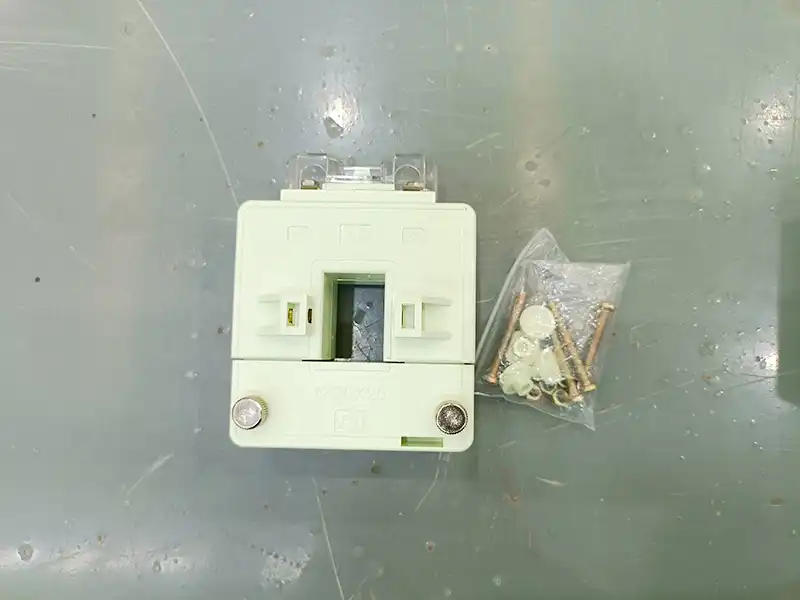
When a large alternating current (I₁) flows through the primary winding, it generates an alternating magnetic flux in the iron core, which induces a proportionally reduced current (I₂) in the secondary winding. The current transformation ratio is essentially the inverse of the turns ratio, i.e., I₁ / I₂ ≈ N₂ / N₁. The standard rated secondary current is typically 5 A or 1 A.
Key Features and Functions:
Safety Isolation: Isolates measurement and protection equipment from high-voltage lines, ensuring the safety of personnel and equipment.
Proportional Scaling: Converts large currents that are difficult to measure directly into easily measurable standard low currents.
High Accuracy Requirements: Within the specified measurement range, both ratio error and phase error must remain within the limits of the defined accuracy class.
Secondary Circuit Must Not Be Open During Operation: An open secondary circuit can induce dangerously high voltages, posing risks to personnel and equipment, and may damage the CT itself.
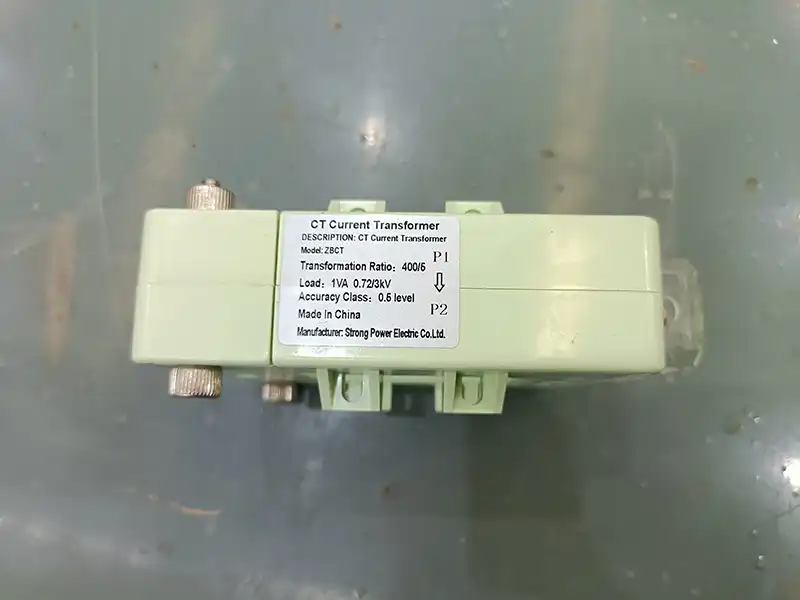
Main Applications:
Energy Metering: Supplies current signals to electricity meters.
Current Measurement: Connects to analog or digital ammeters for system monitoring.
Relay Protection: Delivers fault current signals to protection devices, such as overcurrent and differential relays.
System Monitoring: Used in supervisory control and data acquisition (SCADA) systems and energy management systems.