
What’s the Difference Between Phase and Line Voltage in a Three-Phase System
What is phase voltage?
Phase voltage is the voltage between each phase (live wire) and a common reference point (usually the neutral wire). It is the voltage measured across each phase of the power supply or load winding, i.e., the voltage between the live wire (L) and the neutral wire (N).
What is line voltage?
Line voltage refers to the potential difference between any two phases (live wire). During measurement, the voltmeter leads are connected to two distinct live wires (e.g., L1-L2, L2-L3, or L3-L1).
Core Differences (Comparison Table)
| Feature | Phase Voltage | Line Voltage |
| Measurement Points | Between Line (L) and Neutral (N) | Between any two Lines (L1 and L2, L2 and L3, L3 and L1) |
| Symbol | U_an, U_bn, U_cn (or U_phase) | U_ab, U_bc, U_ca (or U_line) |
| Relationship (in Star/Y Connection) | Line Voltage = √3 × Phase Voltage | Phase Voltage = Line Voltage / √3 |
| Phase Relationship | The three phase voltages are 120° apart from each other. | The line voltage leads its corresponding phase voltage by 30°. |
| Common Value | 220V | 380V |
| Typical Application | Single-phase loads (e.g., household sockets, lighting) | Three-phase loads (e.g., factory motors, large HVAC units) |
The origin of √3 (approximately 1.732) in electrical voltage systems
In a symmetrical three-phase Y system, the voltage between two live wires (L1 and L2) (line voltage) is not simply the sum of the magnitudes of the two phase voltages (L1-N and L2-N), due to the 120° phase difference between them.
Through calculation (using the law of cosines or phasor diagram method), it can be shown that: U_line = √3 × U_phase.
line voltage and phase voltage formula
For example, if the phase voltage U_phase = 220V, then the line voltage U_line = √3 × 220V ≈ 1.732 × 220V ≈ 380V.
Relation between line and phase voltage in delta connection
In a delta connection, the line voltage and phase voltage are the same. That is, U_line = U_phase. In a delta connection, the windings of the three-phase power source or load are connected end-to-end, forming a closed loop. Three wires are drawn from the three connection points as transmission lines (i.e., the three live wires L1, L2, L3), and there is no neutral wire.
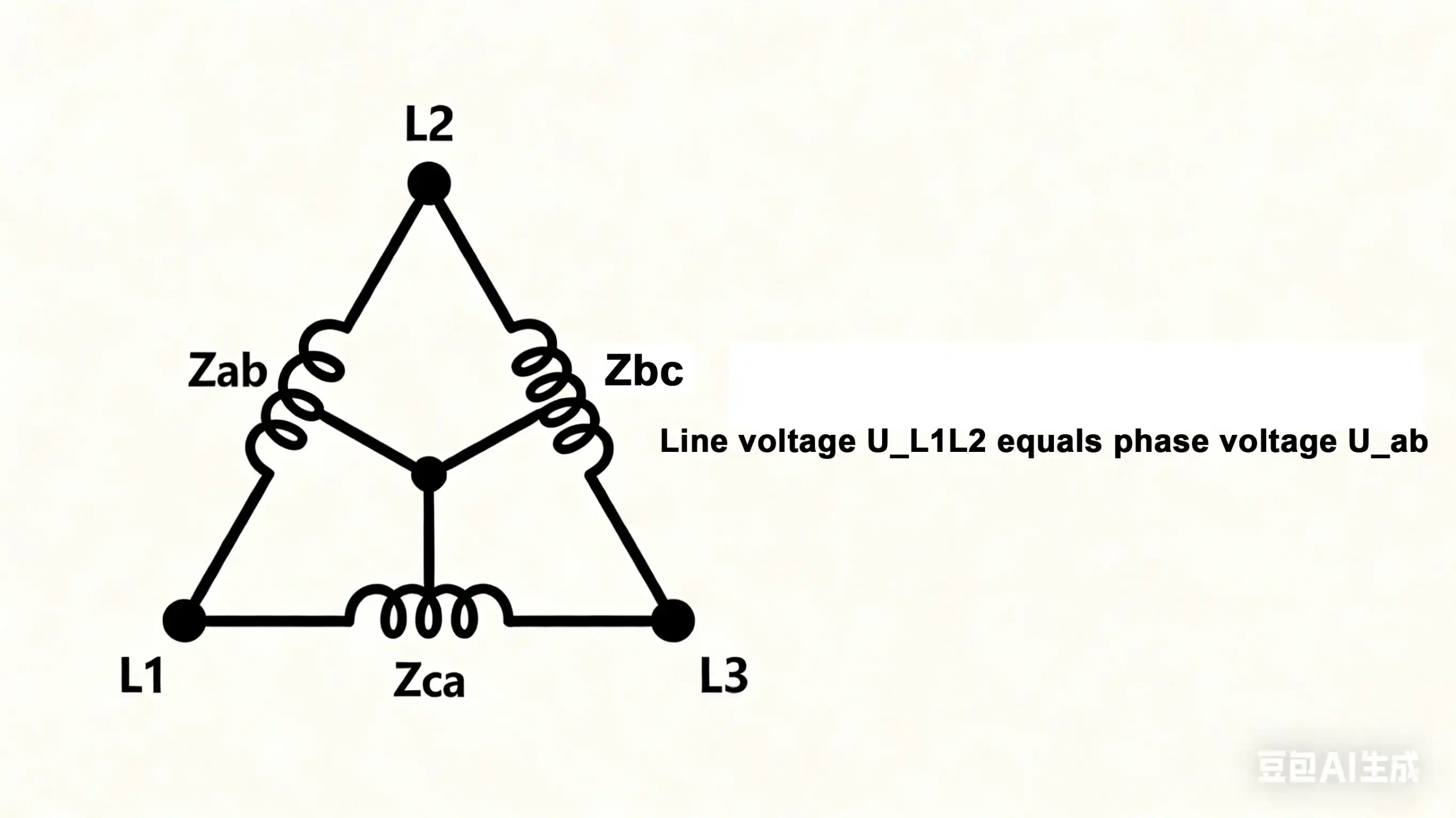
As can be seen from the connection diagram: winding ab is directly connected between live wires L1 and L2. Therefore, the line voltage between L1 and L2 (U_L1L2) is equal to the phase voltage of winding ab (U_ab).
Relation between line and phase voltage in star(Y) connection
In a symmetrical star-connected system, the line voltage is equal to √3 times the phase voltage and leads the corresponding phase voltage by 30° electrical degrees. That is, U_line = √3 × U_phase.
In a star connection, the ends of the three windings (or impedances) of a three-phase power source or load are connected together to form a common point, called the neutral point (N). Three live wires (L1, L2, L3) are drawn from the beginnings of the three windings, and a neutral wire (or ground wire) can be drawn from the neutral point.